
Short answer
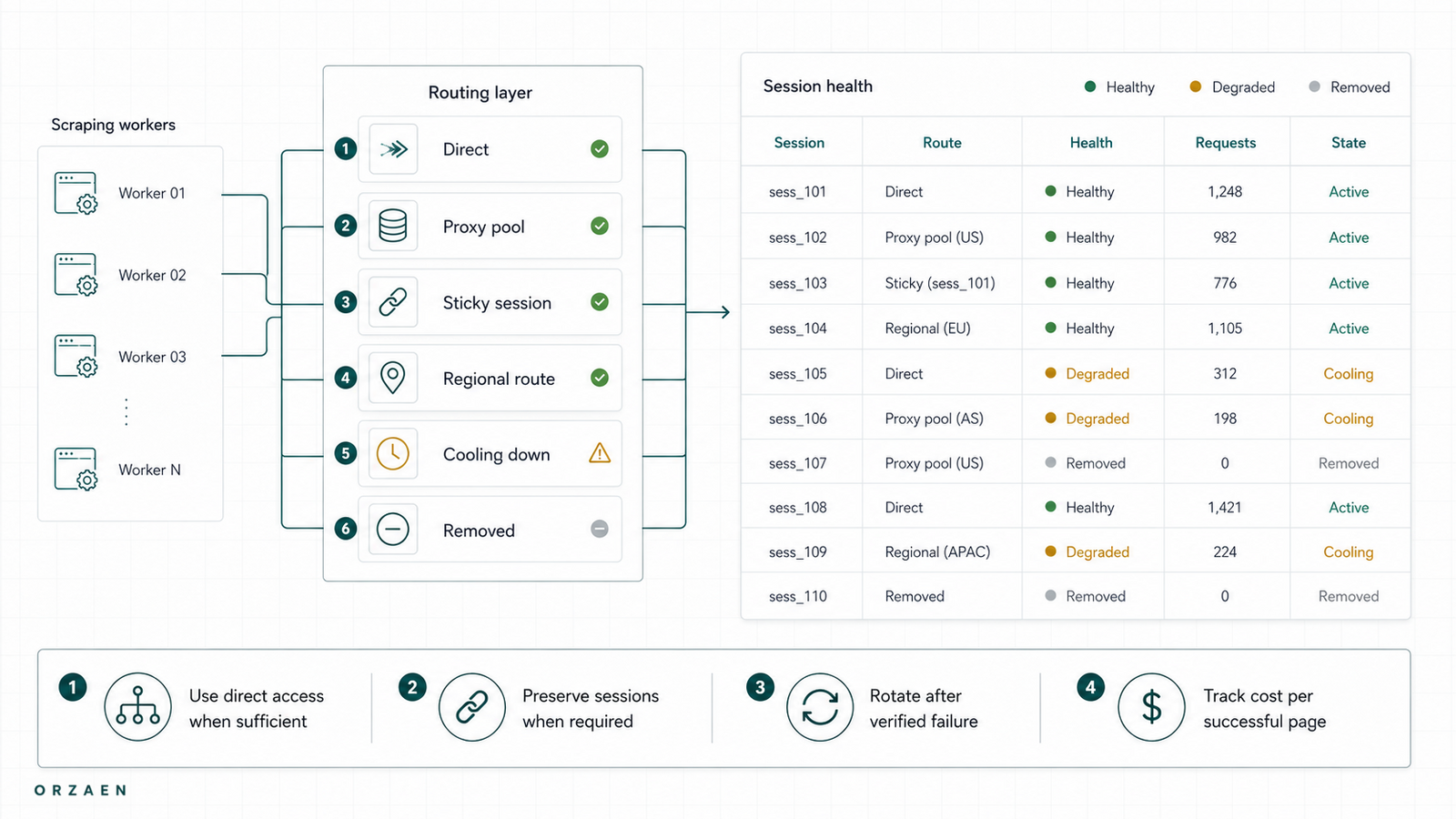
Reliable proxy rotation is not random IP switching. A production proxy layer assigns routes according to source and session requirements, keeps sticky sessions when identity must remain stable, scores routes using valid-response signals, quarantines unhealthy routes, and measures cost per accepted record. It should support a permitted collection method—not be presented as a way to ignore access controls.
Many projects do not need proxies at all. Source review and rate control come first.
When proxies are—and are not—needed
Proxies can be useful for:
- Distributing approved requests across geographic or network routes
- Accessing location-specific public views for an agreed research scope
- Isolating concurrent source sessions
- Reducing dependence on one egress route
- Supporting large, paced collection where the source permits it
They are not a substitute for:
- An official API when it meets the requirement
- Permission or a suitable access path
- Conservative request pacing
- Correct authentication
- A parser that handles the current response
- Coverage and data-quality validation
Start with API vs HTML vs Browser Automation and choose the data surface before designing the proxy layer.
The four parts of a proxy system
| Component | Responsibility | Failure if omitted |
|---|---|---|
| Pool inventory | Store route type, region, provider, state, and limits | Routes become anonymous strings with no control |
| Assignment policy | Match a route to source, task, and session | Sticky sessions break or expensive routes are overused |
| Health model | Score valid responses, latency, and failure classes | Failed routes return to service repeatedly |
| Observability and cost | Measure usage per source and valid record | Cheap-looking traffic produces expensive bad data |
The rotation algorithm is only one piece. Session ownership and response validation matter just as much.
Choose the route tier by the source
Proxy products are commonly grouped as datacenter, residential, ISP, or mobile routes. Labels and billing models vary by provider, so do not assume one type is universally better.
Build a source policy that records:
- Allowed region or country
- Required route type, if any
- Whether a sticky session is required
- Maximum concurrent sessions
- Minimum pacing
- Bandwidth sensitivity
- Expected content and language
- Escalation rule when the route pool is unhealthy
Use the least costly route that produces complete, valid, permitted responses. Do not start every source on the most expensive tier.
Sticky sessions versus rotating every request
Changing IP addresses on every request can break sites that associate cookies, tokens, locale, or authentication with a session.
Use a sticky session when:
- The browser created cookies or tokens on that route
- Several requests form one user-visible workflow
- Location or language must remain consistent
- Pagination state is tied to a session
- A login or consent state is involved
Rotate between sessions or after a diagnosed route failure, not merely because another request is starting.
| Work type | Typical assignment |
|---|---|
| Independent public detail pages | Route can change between bounded tasks |
| Browser login followed by API calls | Keep one route for the session |
| Cursor chain tied to cookies | Keep route and cookie jar together |
| Geographic source observation | Assign a route from the approved region |
| Probe or health check | Use a controlled route and known response |
Build a route health model
A route is healthy only if it produces the expected data, not merely a TCP connection.
Track:
- Valid-response rate by source
403,429, and5xxrates- Timeouts and connection errors
- Median and high-percentile latency
- Challenge, login, or consent response signatures
- Bytes transferred
- Session refresh success
- Cost per valid record
- Last success and last failure time
Health should be source-specific. A route can work for one domain and fail for another.
Use states such as:
new → testing → healthy → degraded → quarantined
                   ↑                    ↓
                   └──── probe success ─┘
Quarantined routes should return only after a cooling period and a controlled probe. Do not place them immediately back into the general pool.
Classify failures before rotating
Not every error means “change proxy.”
| Failure | Likely action |
|---|---|
| Connection error from one route | Retry with a healthy route within budget |
Source 429 across many routes | Reduce source rate and honor Retry-After |
Session-specific 401 or login page | Refresh or stop the session |
403 with policy or access refusal | Review access path; do not rotate blindly |
503 across the source | Pause source and back off |
| Valid response with missing fields | Investigate source or parser, not proxy first |
| Wrong language or region | Correct assignment policy |
The full 403, 429, and temporary-failure guide provides the classification model.
Separate browser state from proxy state
In hybrid collection, the browser may create session state that direct HTTP workers reuse. Bind these values explicitly:
- Proxy route or route group
- Cookie jar
- Headers derived from the browser session
- Token expiry
- User-visible locale
- Created time and last valid time
- Sources and endpoints allowed to use the state
Do not place all tokens and cookies in one shared global pool. A worker using the wrong session-route combination can generate intermittent failures that are hard to reproduce.
Our guide to scraping JavaScript websites without a browser for every request shows where the browser belongs in this architecture.
Control cost per valid record
Proxy billing may depend on bandwidth, request count, port, route, or time. The useful denominator is rarely cost per request. It is cost per valid, reconciled record.
Measure:
proxy cost per valid record = total proxy cost / valid unique records acceptedAlso report:
- Bytes per valid record
- Retries per completed task
- Cost by source and route tier
- Browser versus HTTP traffic
- Duplicate and discarded responses
- Failed tasks remaining after the run
Ways to reduce cost include:
- Avoid loading images, fonts, and media when they are unnecessary
- Use direct HTML or structured responses where appropriate
- Cache approved discovery results within the collection window
- Retry only temporary failures
- Keep unhealthy routes quarantined
- Reuse valid sticky sessions instead of creating them repeatedly
- Separate expensive discovery from cheaper detail extraction
Use a controlled assignment policy
Random choice can overload one provider, region, or route. A controlled selector can consider:
- Source eligibility
- Required region
- Session affinity
- Current health score
- Recent assignment count
- Cost tier
- Cooling or quarantine state
The selector should return “no eligible route” when the pool is unhealthy. Continuing with a known-bad route hides an infrastructure incident inside the dataset.
Validate proxy output for geographic work
When the project requires a location-specific public view, record the observation context:
- Requested region
- Assigned route region
- Language and locale
- Source URL and query
- Collection time
- Returned location signals
Do not infer that a route label guarantees the source returned the intended regional view. Validate the content.
A verified Orzaen pattern
Orzaen's published YouTube hybrid proxy-rotation engine combined browser discovery, direct HTTP extraction, proxy health tracking, and database-backed state. The public result reports approximately fivefold faster processing for that system after separating the heavy browser stage from repeatable extraction.
The transferable lesson is architectural:
- Use browsers only where state or interaction requires them.
- Persist route and session health.
- Separate failure classes.
- Measure valid output rather than raw traffic.
It is not a claim that the same speed change applies to every source.
Monitor the proxy layer
Alerts should distinguish:
- One route failing
- One provider or region degrading
- One source rejecting otherwise healthy routes
- Widespread source unavailability
- Cost increasing while valid output remains flat
- Sessions expiring faster than normal
- Geographic or language content changing
Connect these infrastructure signals to the web-scraping pipeline monitoring layer. A healthy proxy pool does not prove a complete dataset, and a low row count does not automatically prove a proxy problem.
Common proxy mistakes
Rotating on every request
This can break cookie, token, cursor, and locale state. Define session affinity first.
Treating 403 and 429 as the same event
429 usually calls for reduced request rate. 403 needs access and state diagnosis. Blind rotation can worsen both.
Scoring only status codes
A route that returns a 200 login page is not healthy for record extraction. Validate content signatures and required fields.
Using proxies before source review
An official API, downloadable dataset, sitemap, or direct HTML response may meet the need more cleanly.
Ignoring cost after retries
Blocked, repeated, or invalid responses still consume bandwidth. Calculate cost against accepted records.
Frequently asked questions
Do all web scrapers need proxies?
No. Many sources can be collected reliably with direct, conservatively paced requests or an official API. Add proxies only when the approved source design and operational requirements justify them.
Should I rotate the proxy on every request?
Usually not. Independent tasks may use different routes, but cookies, tokens, pagination, login, and geographic state can require a sticky session. Rotate according to task and session boundaries.
Are residential proxies always better?
No. Suitability depends on the source, region, reliability, bandwidth, permitted use, and cost. Test valid-record output rather than relying on the route label.
How should a proxy be marked unhealthy?
Use source-specific evidence such as connection failures, invalid content signatures, repeated 403 or 429 responses, latency, and session failures. Quarantine it, wait, and use a controlled probe before reuse.
What is the best proxy metric?
Cost per valid unique record is more meaningful than cost per request. Pair it with valid-response rate, retries, latency, and failed tasks so cheap but incomplete extraction is visible.
Next step
Start with the scalable web-scraping pipeline, then implement source-aware failure handling before adding more proxy capacity. For a hybrid or proxy-dependent collection system, review Orzaen's Web Scraping & Data Extraction service.
Sources
- Requests proxy documentation (opens in a new tab)
- Playwright network documentation (opens in a new tab)
- Playwright BrowserType proxy options (opens in a new tab)
- urllib3 ProxyManager documentation (opens in a new tab)
- RFC 9110: HTTP Semantics (opens in a new tab)
- RFC 6585: 429 Too Many Requests (opens in a new tab)