
Short answer
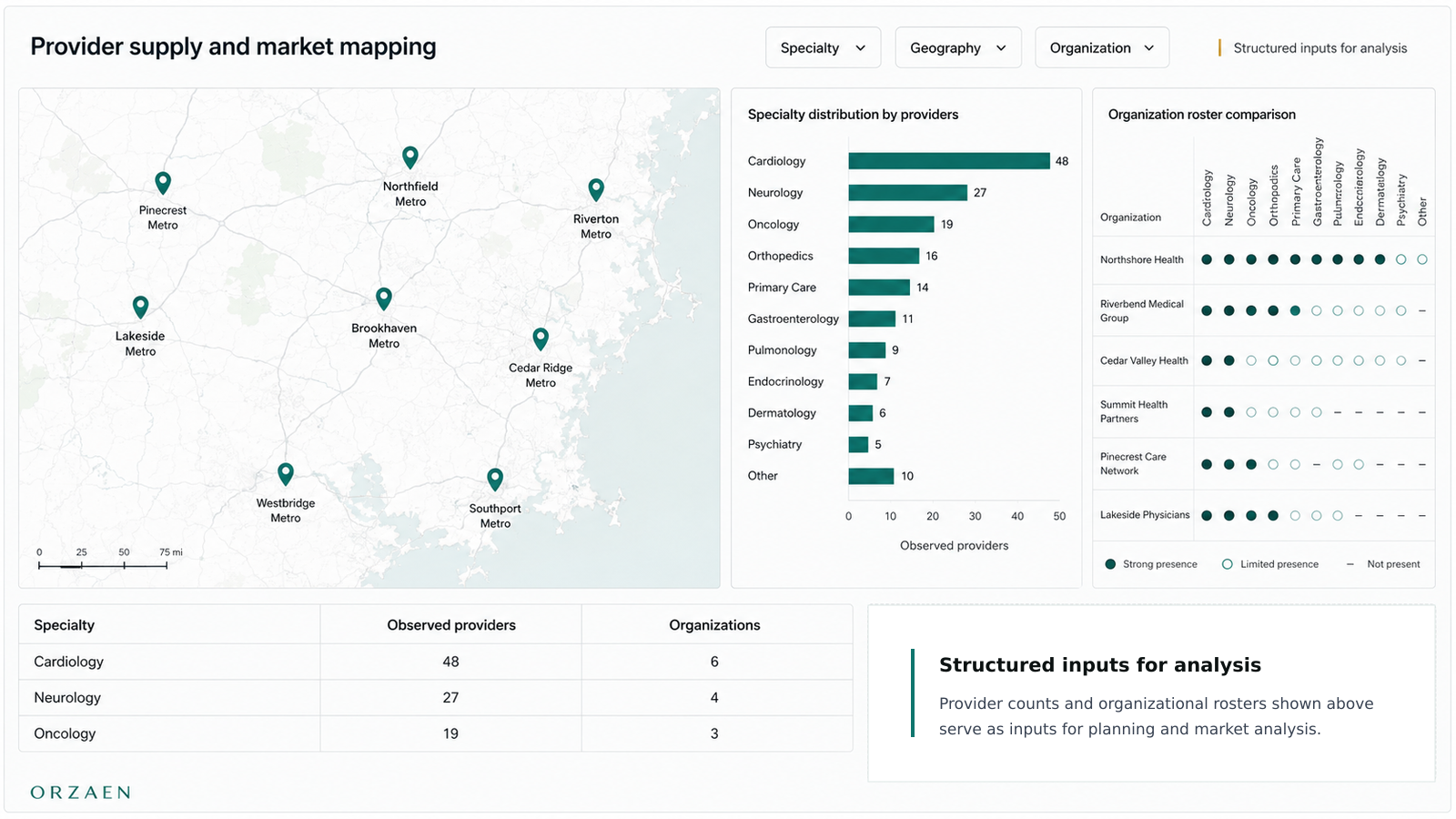
Healthcare planning and analytics teams use provider data to organize the public supply side of a market: which providers are listed, by which organizations, in which specialties, and at which locations. These datasets can support physician-supply research, provider development planning, community-needs work, recruitment prioritization, competitor rosters, territory research, and healthcare products. The dataset is an input; it is not the final strategic conclusion.
The problem provider data solves
A planning engagement may begin with a market, specialty, health system, or service-line question. The relevant public evidence is rarely in one place.
- One hospital publishes providers by department.
- Another health system organizes profiles by location.
- An academic medical center publishes faculty titles and education.
- A physician group publishes a separate practice roster.
- NPPES supplies NPI-related identity and taxonomy data.
- A state board supplies licence-specific public information.
Analysts can research those sources manually, but the work becomes slow and inconsistent when the scope includes dozens of organizations or needs to be repeated for multiple client markets.
Structured provider-data collection separates source acquisition from analysis. The data team gathers and documents the source observations; the healthcare planning team applies its methodology and domain judgment.
Who uses provider-roster data?
| Organization | Typical question | Useful provider-data input |
|---|---|---|
| Provider development and medical staff planning firm | Which specialists are publicly represented in the target market? | Provider, specialty, organization, location, source |
| Healthcare strategy and market-intelligence firm | How do competing health systems present their provider rosters? | Hospital rosters, departments, practices, affiliations |
| Hospital or health system | Which providers and specialties appear across relevant organizations? | Organization-specific public provider observations |
| Physician recruitment or workforce firm | Which specialties and locations should be researched further? | Specialty, geography, public credentials, organization context |
| Provider-data or analytics platform | How can we seed or refresh a provider intelligence layer? | Structured profiles, identifiers, source records, timestamps |
| Digital-health directory or marketplace | Which public provider profiles fit the approved product scope? | Names, specialties, locations, filters, public profile fields |
| Behavioral-health product | Which therapists are publicly listed by specialty and geography? | Therapist type, treatment areas, locations, public contacts |
The same dataset can support several workflows, but the permitted use and final methodology should be defined before collection.
Use case 1: physician-supply and market mapping
A provider roster can organize publicly listed physicians by:
- Specialty and subspecialty
- County, city, ZIP code, or market
- Hospital, health system, practice, or department
- Practice location
- Faculty or leadership role
- Source and collection date
This creates a research-ready supply-side table. It does not, by itself, establish active clinical capacity, full-time equivalents, patient access, referral patterns, or demand.
Those distinctions matter. A physician may appear at several locations. A profile may remain online after a relationship changes. A directory may exclude providers that another source includes. The analytical methodology must decide how to interpret each observation.
Use case 2: provider development and medical staff planning
Provider development planning commonly requires a defensible view of the existing provider landscape. Public provider data can help the planning team:
- Build an initial roster for the target organizations.
- Classify the publicly stated specialties.
- Organize providers by geography and practice location.
- Identify profiles requiring manual qualification.
- Compare the observed roster with other research inputs.
- Prioritize areas for deeper investigation.
Orzaen's role in this workflow is source collection, normalization, and QA. The client determines need, supply assumptions, recruitment priorities, and strategic recommendations.
Use case 3: community-needs research inputs
Community-needs and access work can require provider-supply inputs, but a directory scrape is not a community needs assessment.
A source-specific dataset may provide:
- Observed providers by specialty and market
- Public practice locations
- Hospital and organization context
- Source-published languages or services when relevant
- Collection dates and source links
The assessment itself may require population, utilization, demographics, travel patterns, stakeholder input, claims, surveys, and other evidence. Provider directories are one component.
This separation makes the case study more credible: the collection vendor should not claim to have produced the strategic outcome when it supplied only the data input.
Use case 4: hospital and competitor roster comparison
Public hospital directories are useful for comparing how organizations present their service lines.
A comparison can be organized around:
- Number of observed provider profiles by specialty
- Departments represented
- Locations tied to each provider profile
- Academic or faculty titles
- Practice and medical-group names
- Publicly displayed organizational relationships
Use careful language in the output. "Observed on Hospital A's provider directory" is more defensible than "employed by Hospital A" unless the source explicitly states employment.
Use case 5: recruitment and workforce research
Provider data can help a recruitment team create a research pool by specialty and geography. It can also supply public professional context such as credentials, education, faculty title, and practice organization when published.
The dataset should not automatically become an outreach list. Outreach introduces separate legal, contractual, privacy, consent, and communication requirements. If public email or contact enrichment is part of the approved project, it should be documented as a separate step rather than blended invisibly into directory collection.
Use case 6: provider-data products and directories
Provider-search products need more than names in a spreadsheet. They require:
- Stable internal identifiers
- Source observations and timestamps
- Multiple specialties and locations
- Organization relationships
- Search-friendly normalized fields
- Rules for missing and conflicting values
- Refresh and deletion handling
The HL7 FHIR `PractitionerRole` resource (opens in a new tab) is useful conceptually because it represents the roles, services, specialties, organizations, and locations associated with a practitioner. A product does not have to implement FHIR to learn from its relationship model.
See Healthcare Provider Data Schema Design for a practical relational structure.
Selecting sources from the business question
Start with the decision, not the best-known website.
| Business question | Strong starting sources |
|---|---|
| Which providers does a health system publicly present? | Health-system and hospital provider directories |
| What academic context is published for these physicians? | Academic medical-center and faculty profiles |
| What NPI and taxonomy records are available? | NPPES/NPI Registry and downloadable files |
| What public licence information is available? | Relevant state board source |
| Which behavioral-health providers match a specialty and geography? | Approved behavioral-health directories and practice sites |
| What changed since the previous market snapshot? | Fresh recollection of the same approved source set |
Read NPPES vs Hospital Provider Directories before treating registry and institutional data as interchangeable.
Defining the project scope
A useful scope statement answers seven questions.
1. Which market?
Define country, state, metropolitan area, county, city, ZIP codes, or named organizations.
2. Which provider types or specialties?
Use source terms and an agreed normalization taxonomy. Preserve the original source specialty.
3. Which organizations matter?
List known hospitals and health systems, or define the rules for identifying candidate sources.
4. Which fields are required?
Separate required fields from optional fields. A source should not fail merely because it does not publish an optional academic or affiliation field.
5. What does a row represent?
A provider, provider-location, provider-organization relationship, or source profile can each produce a different valid row count.
6. How fresh must the data be?
Define the collection window and whether previous sources must be fully recollected.
7. How will the data be used?
Planning, product ingestion, recruitment research, and outreach have different boundaries and QA requirements.
Data-quality requirements for planning work
Planning teams need transparency more than a mysterious accuracy score.
A strong delivery documents:
- Sources included and excluded
- Collection timestamps
- Record count by source
- Field coverage by source
- Duplicate rules
- Specialty normalization rules
- NPI match method
- Ambiguous matches requiring review
- Missing and inaccessible pages
- Whether enrichment was performed
One CSV per source can make QA easier because the analyst can compare the source's published structure with its exported records. A combined analytical table can be delivered in addition to—not instead of—source-level files.
A compact provider-market output
provider_name
credentials
specialty_raw
specialty_normalized
organization_name
department
practice_name
location_address
city
state
postal_code
npi
source_url
collected_at
For multiple roles and locations, use a relational model rather than adding location_1, location_2, and location_3 columns indefinitely.
What the dataset cannot conclude by itself
Public provider data does not independently prove:
- Employment status
- Current appointment availability
- Contractual network participation
- Active clinical workload
- Full-time equivalent supply
- Licence or credential status
- Community need
- Market demand
- Recruitment feasibility
It supplies source-specific evidence that a qualified team can combine with other inputs.
Frequently asked questions
Can provider-directory data support a community needs assessment?
Yes, as a provider-supply input. It can help organize publicly listed providers by specialty, geography, and organization. The final assessment requires its own methodology and normally incorporates additional demographic, utilization, access, and stakeholder evidence.
Can Orzaen identify the sources if the client only provides a market?
Yes, source discovery can be included. Candidate hospital, health-system, practice, registry, and professional sources are reviewed for relevance, public accessibility, fields, and feasibility before collection begins.
Is a public hospital roster the same as an employee list?
No. It is a record of what the organization publicly displayed at collection time. The relationship could represent employment, privileges, faculty status, a group relationship, or another arrangement. Preserve the source wording.
Can several hospital directories be combined into one schema?
Yes. The pipeline can normalize a core set of fields while retaining raw values and optional source-specific fields. Source URLs and collection dates should remain attached so the combined record is auditable.
Should earlier provider files be reused for a new engagement?
Only if their age and purpose are acceptable to the client. When the goal is a current market snapshot, perform a fresh collection instead of presenting an old export as current.
Next step
Read the Healthcare Provider Data Collection Guide for sources and fields, or review Orzaen's Healthcare Provider Data Collection offer. The recurring provider-directory case study shows how typical 5–20-source batches were delivered for more than three years.