
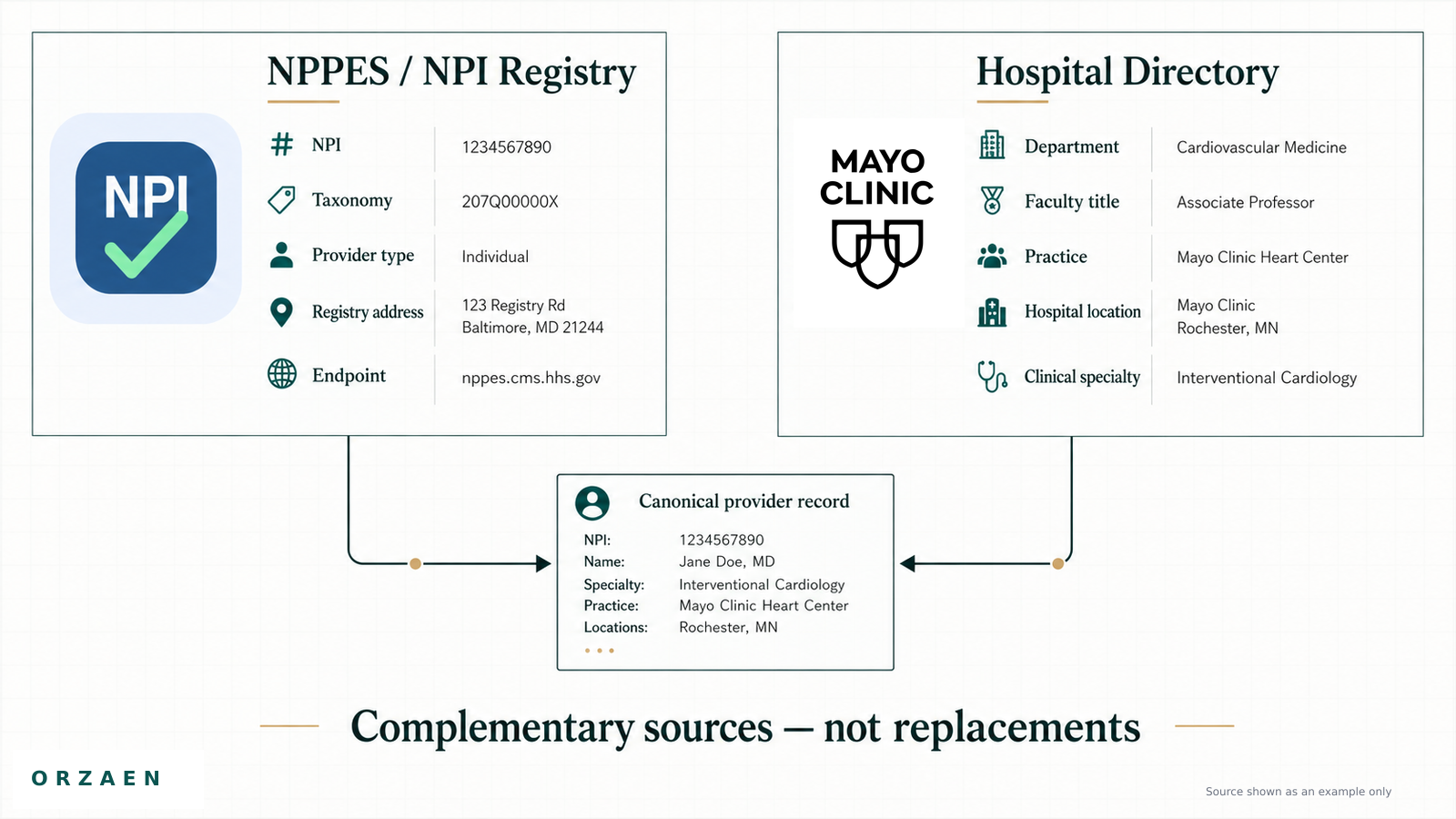
Short answer
Use NPPES when you need NPI-based provider identity, taxonomy, published addresses, and related registry fields. Use hospital provider directories when you need organization-specific rosters, departments, faculty titles, practice locations, or relationships displayed by a particular health system. For many planning, analytics, and directory projects, the strongest dataset keeps both sources and their provenance rather than treating one as a replacement for the other.
What NPPES is designed to do
The National Plan and Provider Enumeration System assigns National Provider Identifiers to healthcare providers. CMS describes an NPI as a unique, 10-position, intelligence-free numeric identifier used in HIPAA standard transactions. "Intelligence-free" means the digits themselves do not encode a provider's state, specialty, or other attributes.
The NPI Registry (opens in a new tab) provides public search, and CMS publishes downloadable files for larger-scale use. As of July 2026, the NPPES downloadable-file page (opens in a new tab) lists:
- A monthly full Version 2 file
- A monthly deactivation update
- Weekly incremental Version 2 files
- Reference files for other organization names, non-primary practice locations, and endpoints
NPPES is therefore an important provider identity source. But CMS also states that issuance of an NPI does not ensure or validate that a provider is licensed or credentialed.
What a hospital provider directory is designed to do
A hospital or health-system directory presents the providers that the organization chooses to display to patients, referring providers, or the public. A profile may include:
- Name and credentials
- Specialty or clinical interests
- Hospital, practice, and department
- Faculty or leadership title
- Locations and public contact information
- Education, training, and biography
- Appointment or referral links
- Languages, services, and accepted plans when published
This is an organization-specific publication, not a universal identity registry. A provider may appear in several directories, appear differently across them, or be absent even when another source shows a relationship.
NPPES and hospital directories compared
| Dimension | NPPES/NPI data | Hospital or health-system directory |
|---|---|---|
| Primary purpose | Assign and publish NPI-related provider identity data | Present an organization's public provider roster |
| Coverage | Broad U.S. NPI population | Providers displayed by one organization or network |
| Identifier | NPI is central | NPI may be published, hidden, or absent |
| Specialty | Taxonomy codes and descriptions | Source-specific clinical specialty or department wording |
| Organization relationship | Limited and not equivalent to a complete current affiliation map | Organization-specific relationship as publicly displayed |
| Locations | Mailing and practice-location fields, including reference files | Locations associated with the organization's profile |
| Faculty title and department | Generally not the focus | Common on academic medical-center profiles when published |
| Education and biography | Not the main source | Often available on provider detail pages |
| Licence or credential validation | Not provided merely by NPI issuance | Not independently established by directory appearance |
| Update model | Monthly full and weekly incremental files | Varies by organization; often no machine-readable change feed |
| Best use | Identity layer, NPI lookup, taxonomy, matching inputs | Roster, institutional context, source-specific market research |
Why NPPES alone may not answer a market question
Imagine a healthcare strategy team asking:
Which cardiologists are publicly presented by the three health systems serving this market, and at which locations?
NPPES can help identify candidate providers and NPIs, but it does not automatically recreate the current roster presented on each health system's website. The hospital directories supply the organization-specific observation. The result may still require review because public appearance does not necessarily prove employment, contractual network status, availability, or credentialing.
The correct record is therefore not simply:
Provider -> HospitalIt is closer to:
Provider
  observed on -> Hospital directory
  at -> Source URL
  with role -> Cardiology
  at location -> Clinic A
  collected at -> 2026-07-21
That timestamped observation model prevents a source-specific relationship from becoming an unsupported universal fact.
Why hospital directories alone may not answer an identity question
Hospital profiles frequently omit NPI. Names and credentials can vary:
- "Alexandra M. Smith, MD"
- "Alexandra Smith"
- "A. Smith, M.D."
A common name may represent more than one provider. NPPES can supply candidate identity records, but matching must use multiple signals such as name, specialty or taxonomy, practice address, organization, and geography.
Do not assign an NPI solely because the name looks similar. A defensible matching pipeline records:
- The NPPES candidates considered
- The fields used in the decision
- Exact and normalized values
- Match confidence or rule outcome
- Whether the match needs manual review
A source-preserving combined model
Avoid copying NPPES values over hospital-directory values. Store both observations.
{
  "provider_id": "internal-uuid",
  "npi": "1234567890",
  "observations": [
    {
      "source_type": "nppes",
      "source_id": "1234567890",
      "specialty_raw": "Internal Medicine",
      "collected_at": "2026-07-21T00:00:00Z"
    },
    {
      "source_type": "hospital_directory",
      "source_url": "https://example.org/physicians/alexandra-smith",
      "organization_raw": "Example Heart Institute",
      "specialty_raw": "Advanced Heart Failure and Transplant Cardiology",
      "collected_at": "2026-07-21T00:00:00Z"
    }
  ]
}
The example is intentionally small. A production schema should model locations, organizations, affiliations, source records, and change history separately. See Healthcare Provider Data Schema Design for that architecture.
How to decide which source to use
Use NPPES first when you need:
- NPI-based identity
- Individual versus organization provider type
- Taxonomy codes
- Published NPPES addresses
- Bulk national registry data
- Weekly incremental registry updates
Use hospital directories first when you need:
- A specific hospital or health-system roster
- Departments and service-line presentation
- Faculty titles and academic context
- Organization-specific practice locations
- Public biographies, education, or clinical interests
- A current source snapshot for a defined market
Use both when you need:
- NPI-linked hospital rosters
- Provider identity plus institutional context
- Cross-system roster comparison
- A directory or analytics product with source provenance
- Repeatable provider-market snapshots
Use another authoritative source when you need:
- Medical licence status
- Board-specific disciplinary information
- Formal credential verification
- Contractual network participation
- Patient or claims information
Neither NPPES nor a hospital marketing directory should be stretched to answer a question it was not built to answer.
Technical ingestion differences
NPPES bulk ingestion
The bulk files are structured but large. A typical pipeline should:
- Download the approved monthly or weekly file.
- Verify file and schema expectations.
- Stream records instead of loading the full extracted file into memory.
- Normalize column names and multivalue fields.
- Store the raw release identifier.
- Apply deactivation and incremental updates with an audit log.
- Preserve earlier observations where history matters.
Hospital-directory ingestion
Each directory can require a different adapter:
- Discover listing, search, pagination, sitemap, or permitted public endpoints.
- Extract provider profile URLs.
- Fetch detail pages at an appropriate rate.
- Parse source-specific fields.
- Normalize into the core schema.
- Retain raw values, source URL, and collection time.
- Monitor source-structure and record-count changes.
The architecture is covered in How to Build a Multi-Source Healthcare Provider Data Pipeline.
What about CMS Provider Directory APIs?
CMS also requires certain impacted payers to make provider directory information available through public-facing APIs. CMS's Provider Directory API guidance (opens in a new tab) explains that these APIs must be publicly available, although an application may still need to register for an API key. CMS points to the HL7 FHIR Da Vinci PDex Plan-Net implementation guide for provider-directory interoperability.
These payer directories answer a network-directory question, which is again different from NPPES identity data and from a hospital's public physician roster. "Provider directory" is a category, not one universal database.
Data-quality rules for combining sources
Use rules that preserve disagreement instead of hiding it:
- Keep raw and normalized values.
- Attach every relationship to a source and collection time.
- Do not treat a missing profile as proof that a relationship ended.
- Do not treat directory appearance as independent credential verification.
- Separate NPI match status from provider-record completeness.
- Allow one provider to have multiple organizations, specialties, roles, and locations.
- Route ambiguous matches to review instead of forcing a single result.
Frequently asked questions
Is NPPES a complete list of licensed physicians?
No. NPPES contains NPI records for individual and organizational healthcare providers. CMS explicitly states that NPI issuance does not ensure or validate licensing or credentialing. Use the relevant licensing authority and verification process for licence conclusions.
Does a hospital-directory profile prove that a physician is employed by the hospital?
Not necessarily. It proves that the source displayed the provider at the time of collection. The relationship could represent employment, practice privileges, faculty status, a medical group relationship, or another arrangement. Preserve the source wording and avoid strengthening it without evidence.
Can an NPI be matched to a hospital profile automatically?
Sometimes, especially when the profile publishes the NPI or when several identity fields align exactly. Ambiguous names, locations, and specialties require stronger rules or manual review. Name similarity alone is not enough.
Which source is better for physician-supply analysis?
It depends on the methodology. NPPES can supply broad identity and taxonomy inputs; hospital directories add organization-specific roster context. Supply-and-demand methodology, active-practice rules, and final conclusions remain the responsibility of the analytical team.
How frequently does NPPES change?
CMS currently publishes a monthly full Version 2 file and weekly incremental files. That publication cadence does not guarantee that every provider updates their record immediately when their circumstances change.
Next step
For a defined market, Orzaen can collect approved public hospital and provider sources and keep NPPES values separate from source-specific observations. Review the Healthcare Provider Data Collection offer or see the recurring hospital provider-directory case study.