
Short answer
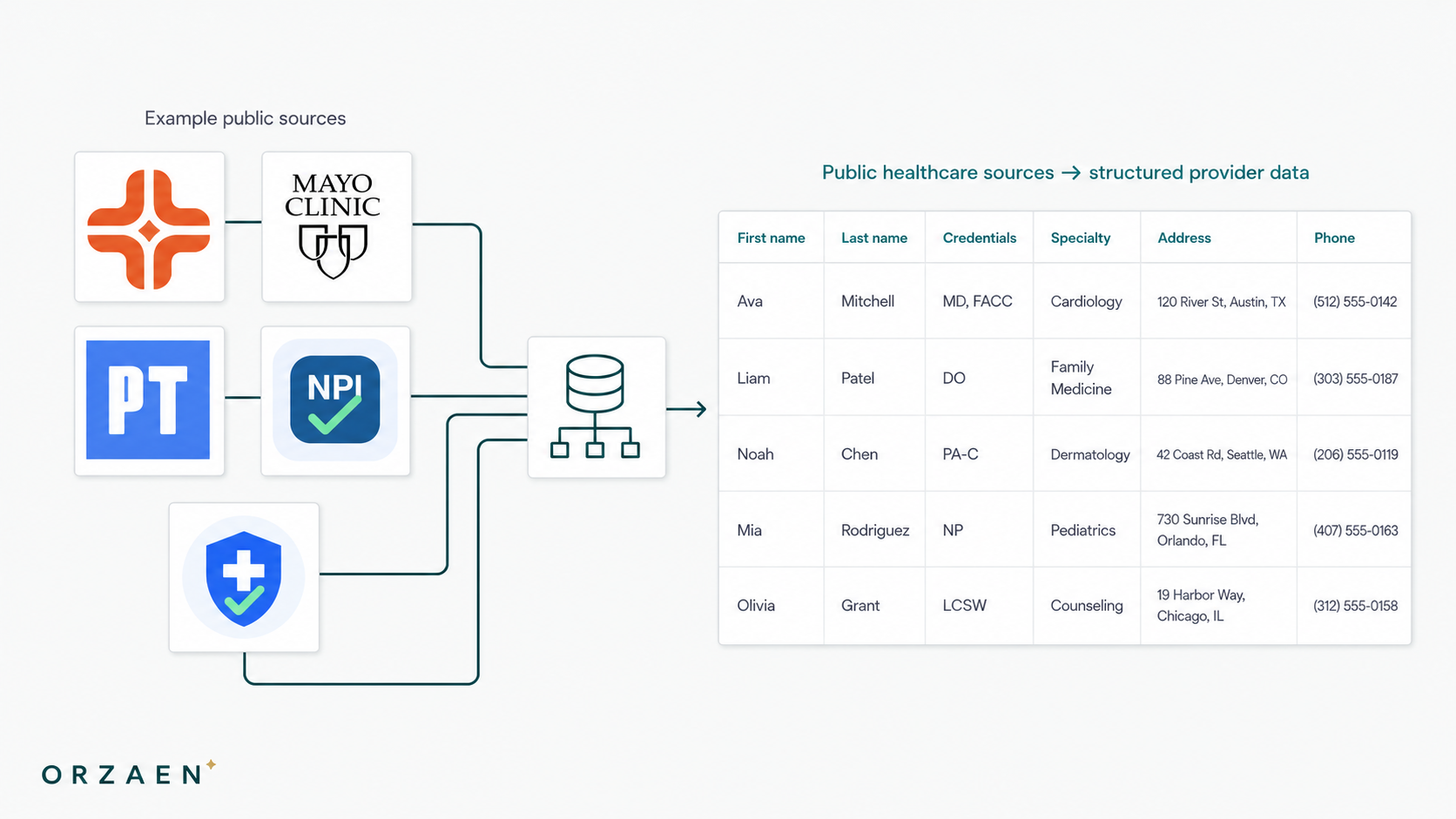
Healthcare provider data collection is the process of gathering public professional information about physicians, therapists, practices, facilities, locations, specialties, and organizational relationships from approved sources and converting it into a consistent dataset. Common sources include hospital directories, health-system websites, academic medical-center profiles, professional directories, state boards, and CMS provider datasets.
The difficult part is rarely finding one provider. It is collecting many sources consistently while preserving what each source actually published.
What counts as healthcare provider data?
Provider data describes a healthcare professional or organization in a professional capacity. Depending on the source, it may include:
- Provider name and credentials
- Specialty and subspecialty
- Practice, hospital, or health-system name
- Department and faculty title
- Public business phone or fax
- Practice address, city, state, and ZIP code
- National Provider Identifier (NPI)
- Education or graduation year
- Publicly displayed hospital or network affiliation
- Profile URL and collection date
This is different from patient or clinical data. A provider directory project should not quietly expand into collecting patient names, appointments, diagnoses, treatments, claims, or medical records. The HHS summary of the HIPAA Privacy Rule (opens in a new tab) explains that protected health information concerns identifiable information related to a person's health, care, or payment for care.
Public professional data still deserves careful handling. Public availability does not remove the need to review source terms, access instructions, privacy requirements, permitted use, and data-security controls.
The main provider-data sources
No single source answers every provider question. The right source depends on the decision or product the dataset will support.
| Source type | Common public fields | Where it is useful | Main limitation |
|---|---|---|---|
| Hospital and health-system directories | Name, credentials, specialty, locations, practice, department, hospital relationship | Provider rosters, market research, specialty coverage | Organization-specific rather than national |
| Academic medical-center directories | Faculty title, department, education, biography, specialty, locations | Academic-provider and workforce research | Fields are often embedded in narrative pages |
| Practice and medical-group websites | Providers, services, locations, phones, practice relationships | Local market and practice coverage | Small sources with inconsistent layouts |
| NPPES/NPI data | NPI, provider type, taxonomy, names, addresses, endpoints | Provider identity and record matching | NPI issuance does not validate licensing or credentialing |
| State medical boards | Public licence status and board-specific professional fields | Licence research and source comparison | Structure and access vary by state |
| Professional and specialty directories | Source-specific credentials, services, contact fields, profiles | Specialty research and directory products | Coverage reflects the particular platform |
| Behavioral-health directories | Therapist type, specialties, treatment areas, fees, locations, public contacts | Behavioral-health products and market mapping | Profile completeness varies significantly |
CMS publishes both a public NPI Registry (opens in a new tab) and downloadable NPPES files. As of July 2026, the NPI file page (opens in a new tab) provides a monthly full Version 2 file and weekly incremental files. CMS also states that receiving an NPI does not ensure that a provider is licensed or credentialed.
That makes NPI valuable as an identity key, but not a replacement for every hospital, professional, affiliation, or licence source.
Why organizations collect source-specific provider data
Provider-supply and market mapping
Healthcare planning and analytics teams may need to organize providers by specialty, geography, organization, or practice location. Public directories supply one part of the evidence used in client-led physician-supply, service-line, or market studies.
Medical staff and recruitment planning
Provider rosters can help a team understand which specialties are publicly represented in a market and which organizations list particular clinicians. The dataset can support recruitment prioritization, but it does not independently prove workforce need or provider availability.
Hospital and competitor roster comparison
Hospital websites often provide institutional context that a national identity registry does not: departments, faculty positions, practice groups, and the organizations presenting a provider as part of their public roster.
Provider directories and digital-health products
A directory, marketplace, analytics product, or AI application may need structured provider profiles for search, filters, internal research, or product seeding. The source and intended use should be approved before collection begins.
Recurring market snapshots
Provider rosters change. A team that studied a market six or twelve months ago may need a fresh collection rather than a copy of the earlier export. A refresh should clearly distinguish current source observations from historical records.
For a deeper buyer-focused explanation, see How Healthcare Planning and Analytics Teams Use Provider Data.
A practical provider-data schema
A flat CSV can work for a small project, but the fields still need explicit definitions.
| Field | Recommended meaning |
|---|---|
provider_name_raw | Name exactly as published by the source |
first_name, middle_name, last_name | Parsed name components when reliably separable |
credentials_raw | Credentials as displayed, without silently changing their meaning |
specialty_raw | Source-published specialty text |
specialty_normalized | Agreed reporting category derived from the raw value |
organization_name | Practice, hospital, group, or institution tied to this source record |
department | Department explicitly published by the source |
faculty_title | Academic or faculty position when published |
phone, fax | Public professional contact fields |
address, city, state, postal_code | Practice or organization location represented by the record |
npi | NPI when published or matched under an approved rule |
source_url | Page from which the record was collected |
collected_at | Timestamp of the source observation |
Never overwrite the raw value with a normalized one. Keeping both makes it possible to audit a classification or change the normalization rules later.
Larger systems should model providers, organizations, locations, and affiliations separately. A physician can work at several organizations and locations, and each relationship may have its own specialty, role, phone, or validity period. The HL7 FHIR `PractitionerRole` resource (opens in a new tab) reflects this relationship-oriented model: it describes the roles or services a practitioner performs for an organization at locations.
Our technical article on Healthcare Provider Data Schema Design shows a relational model and implementation example.
The collection workflow
1. Define the question before the sources
Start with:
- Target geography
- Specialties or provider types
- Organizations or source categories
- Required and optional fields
- Intended use
- Output format
- Freshness requirement
A request for "all physician data" is not a workable scope. A request for cardiologists publicly listed by 14 health systems in three metropolitan areas is much closer.
2. Review source accessibility and coverage
For every source, confirm:
- What the listing pages expose
- Whether provider detail pages contain additional fields
- How pagination or geographic search works
- Whether sitemaps or structured data are available
- Source terms, robots directives, and rate expectations
- Which fields are frequently absent
- Whether collection is technically and operationally feasible
Source names should not be treated as guaranteed coverage. A source may change its structure, restrict access, remove fields, or become unsuitable for the project.
3. Build a source map
Create an explicit mapping before collection:
Source field: "Clinical Interests"
Raw target: specialty_raw
Normalized target: specialty_normalized
Required: no
Multi-value: yes
Source page: provider detail
This prevents two developers or two collection cycles, from interpreting the same field differently.
4. Preserve raw source observations
Store enough raw evidence to reproduce or audit the parsed record where permitted. At minimum, retain the source URL, collection time, raw field values, and parser version. For larger pipelines, a raw HTML or JSON snapshot can be valuable, subject to storage and source constraints.
5. Normalize conservatively
Normalization should make records comparable without turning assumptions into facts.
Good normalization:
- Standardizing state abbreviations
- Separating a clearly structured name
- Converting phone numbers to a consistent representation
- Mapping source specialties into an agreed reporting taxonomy while retaining the raw specialty
Risky inference:
- Treating a missing hospital name as proof of no affiliation
- Assigning an NPI based only on a common name
- Converting a biography statement into a current credential without a clear rule
- Filling missing contact details from an unrelated source without disclosing enrichment
6. Run source-aware QA
Quality checks should include:
- Duplicate source URLs
- Duplicate provider-location records
- Invalid state or postal-code formats
- Phone and fax formatting
- Unexpected drops in record count
- Required-field coverage by source
- Unusually high missingness after a parser change
- Source URL and collection timestamp presence
Accuracy cannot be represented by one percentage unless the measurement method and sample are defined. A more useful delivery includes field coverage, exception counts, and QA rules.
7. Deliver with provenance
For small and medium projects, one CSV per source often provides the clearest review path. A combined file can then be added if the buyer needs cross-source analysis. JSON, database tables, or an API are more appropriate when relationships or repeated refreshes matter.
See How to Build a Multi-Source Healthcare Provider Data Pipeline for the engineering architecture behind this process.
NPPES data versus hospital-directory data
NPPES and hospital directories should usually be treated as complementary observations.
- NPPES helps identify an individual or organization through an NPI and published registry fields.
- A hospital directory describes what that hospital or health system currently publishes about a provider.
- A state board may publish licence-specific information.
- A professional directory may publish platform-specific services, credentials, or contact fields.
Combining these sources requires explicit matching rules and provenance. Read NPPES vs Hospital Provider Directories before designing a combined dataset.
How often should provider data be refreshed?
There is no universal cadence.
- A one-time market study may require one fresh snapshot.
- A directory product may need scheduled monitoring.
- A recurring consulting engagement may recollect the approved source set every six or twelve months.
- A high-change source may justify more frequent updates.
The right decision depends on source volatility, business impact, collection cost, and whether the source exposes trustworthy update signals. Our guide to Provider Directory Refresh and Change Detection explains full recollection, hashes, incremental updates, and change logs.
Frequently asked questions
Is public healthcare provider data the same as patient data?
No. Public provider data describes professionals and organizations in their professional capacity. Patient data concerns identifiable individuals receiving care, their health, treatment, or payment information. A provider-directory project should define and enforce this boundary instead of assuming the word "public" resolves every privacy question.
Do I need to provide every website?
Not necessarily. A buyer can provide a known source list, or the project can begin with source discovery based on specialty, geography, and organization type. Every proposed source still requires an accessibility, field-coverage, and feasibility review.
Can NPPES replace hospital provider directories?
Usually not. NPPES is valuable for NPI-related identity and taxonomy data, while hospital directories may publish departments, faculty titles, practice groups, locations, and organization-specific relationships. The sources answer different questions.
Does an NPI prove that a provider is licensed or credentialed?
No. CMS explicitly states that NPI issuance does not ensure or validate licensing or credentialing. Licence or credential verification requires the appropriate authoritative process and should not be inferred from an NPI record.
Can the data be refreshed later?
Yes. A later project can recollect the same approved sources and compare the new observations with the previous snapshot. Added, changed, and missing records should be reported separately, because a missing profile is not automatically proof that a provider left an organization.
Next step
If you already know the specialty, geography, organizations, or websites you need, review Orzaen's Healthcare Provider Data Collection offer. For proof of recurring delivery, see the hospital provider-directory collection case study and the Psychology Today therapist-directory extraction.
Sources
- CMS NPPES NPI Registry (opens in a new tab)
- CMS NPPES downloadable files (opens in a new tab)
- CMS National Provider Identifier standard (opens in a new tab)
- CMS Provider Data Catalog (opens in a new tab)
- HHS Summary of the HIPAA Privacy Rule (opens in a new tab)
- HL7 FHIR PractitionerRole (opens in a new tab)