
Short answer
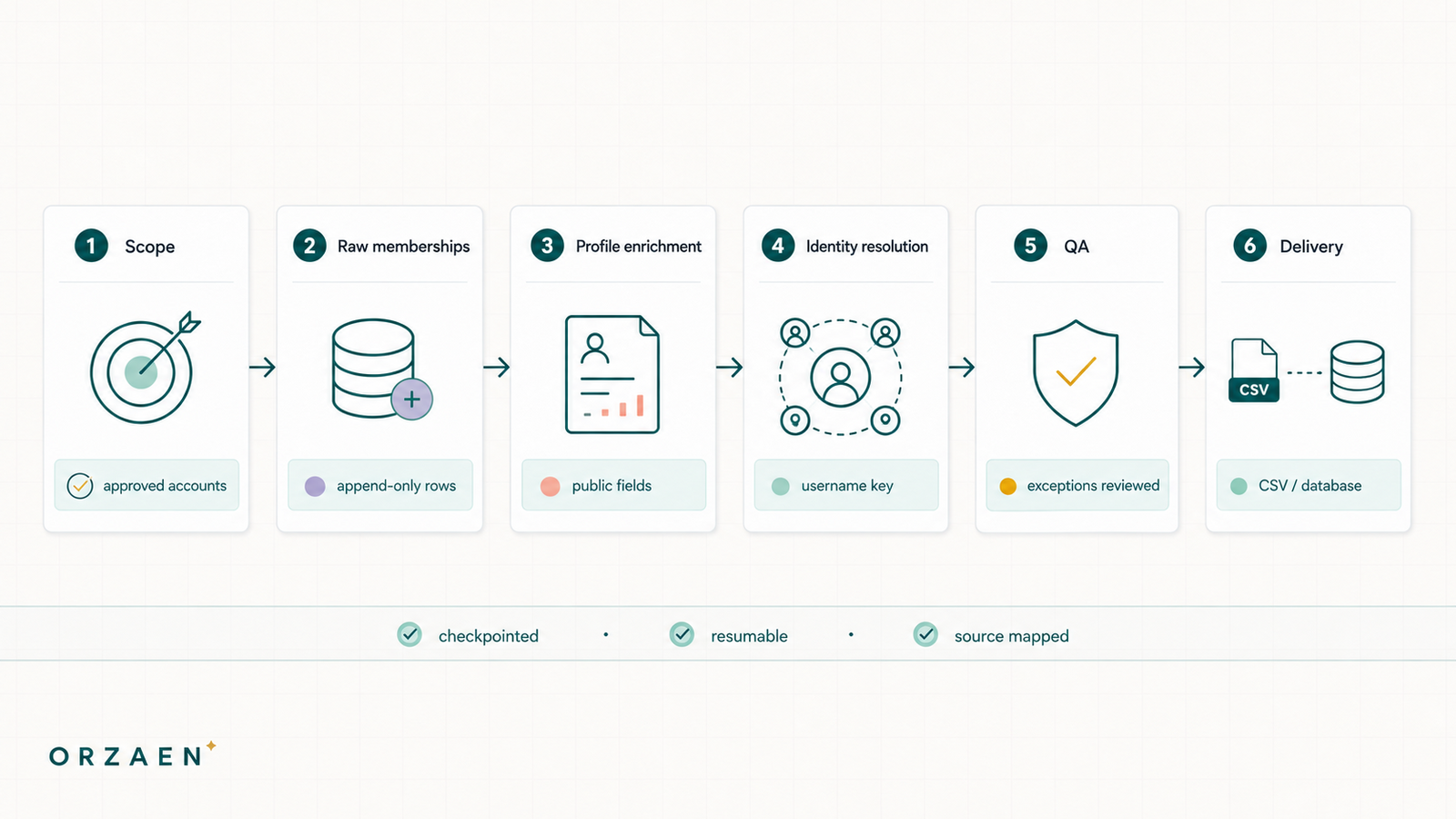
A reliable multi-account Instagram data pipeline separates source scoping, audience membership, public profile enrichment, identity resolution, quality assurance, and delivery into resumable stages.
Do not collect directly into one final spreadsheet. Preserve raw source relationships, use deterministic keys, checkpoint every stage, make writes idempotent, and report requested, collected, accepted, unique, enriched, unavailable, and failed records separately.
Why a pipeline is necessary
A one-account follower export can sometimes be treated as a file-generation task. A multi-account project cannot.
Consider a scope with 19 public category accounts and an estimated 222,000 unique followers. The system may encounter:
- the same profile under several source accounts;
- repeated rows within one source;
- usernames that change;
- private or unavailable profiles;
- optional public profile fields with low coverage;
- interruptions during pagination or enrichment;
- source counts that change during collection;
- deliverables that require both source-level and master files.
If the workflow writes only to a final workbook, one interrupted stage can force a complete rerun. If it removes duplicates too early, it destroys the source membership needed for overlap analysis.
The pipeline should therefore model each observation before it models the final output.
Reference architecture
| Layer | Responsibility | Durable output |
|---|---|---|
| Scope | Approved accounts, posts, population, fields, limits, and use | Source manifest |
| Collection | Accessible audience identities or comments by source | Raw source responses and membership rows |
| Enrichment | Public profile observations for accepted unique identities | Versioned profile observations |
| Resolution | Stable profile keys, username history, and cross-source membership | Master profiles and membership bridge |
| QA | Counts, duplicates, missing fields, failures, and exceptions | Run summary and exception queue |
| Delivery | Source files, master tables, documentation, and exports | CSV, Excel, JSON, or database handoff |
This structure is independent of a particular approved acquisition route. The source adapter may change, but the data contracts between stages should remain stable.
1. Start with a source manifest
The source manifest is the pipeline's control plane. One row represents one approved source population.
source_id
source_account
source_url
population_type
requested_limit
requested_fields_version
intended_use
collection_status
started_at
completed_at
displayed_count_observed
raw_rows_collected
accepted_memberships
status_note
population_type might be followers, following, or comments. Keep it explicit. A source account's followers and commenters are not one interchangeable population.
The manifest should also preserve the scope version. If the client adds fields halfway through, the run must show which sources were collected or enriched under which schema.
2. Store audience membership before profile enrichment
An audience-membership row answers:
Which observed identity appeared under which approved source during which run?
run_id
source_id
instagram_user_id
username_observed
display_name_observed
profile_url
is_private_observed
is_verified_observed
membership_observed_at
raw_reference
row_status
The unique key should be deterministic. For example:
(run_id, source_id, instagram_user_id)When a stable platform user ID is not legitimately available, the pipeline may temporarily use a normalized username key and record that identity resolution is weaker.
Do not enrich each repeated membership independently. First collect memberships, then build the unique profile work queue. A profile appearing under seven sources should normally be enriched once per snapshot, not seven times.
3. Preserve raw observations
Raw data is not the public website itself. It is the exact response or parsed record retained by the approved workflow for reproducibility, debugging, and reprocessing, subject to the project's retention and security rules.
Keep raw and normalized values separate:
| Raw field | Normalized field |
|---|---|
username_observed | username_normalized |
bio_raw | parsed mentions, hashtags, and contact candidates |
external_url_raw | canonical URL and domain |
followers_text | integer count when safely parsed |
| source timestamp | RFC 3339 UTC timestamp |
Normalization bugs can then be corrected without recollecting the source.
W3C's provenance model describes provenance as information about the entities, activities, and people involved in producing data. A practical Instagram dataset does not need a full semantic-web implementation, but the principle is useful: preserve what was observed, where, when, and by which run.
4. Use stage-specific queues
A production workflow should not place every task in one undifferentiated queue.
Recommended queues or status partitions:
source_collection_pendingsource_collection_retryablemembership_acceptedprofile_enrichment_pendingprofile_enrichment_retryableprofile_unavailableidentity_review_requireddelivery_ready
Each task needs:
task_id
run_id
stage
subject_key
attempt_count
first_attempt_at
last_attempt_at
next_attempt_at
status
error_class
error_message_safe
Store a safe error class instead of only a long stack trace. It should be possible to report “312 unavailable profiles, 47 temporary failures, and 6 identity conflicts” without reading worker logs manually.
5. Make every write idempotent
Idempotency means retrying the same accepted task does not create a second logical record.
A small Python example shows the contract:
from dataclasses import dataclass
from datetime import datetime, timezone


@dataclass(frozen=True)
class Membership:
    run_id: str
    source_id: str
    profile_key: str
    username_observed: str
    observed_at: str

    @property
    def idempotency_key(self) -> tuple[str, str, str]:
        return (self.run_id, self.source_id, self.profile_key)


def utc_now() -> str:
    return datetime.now(timezone.utc).isoformat()
The database should enforce the same uniqueness rule represented by idempotency_key. Application-only duplicate checks are not enough when several workers run concurrently.
This code does not collect Instagram data. It only illustrates the durable record contract after an approved source adapter returns an observation.
6. Checkpoint pagination and batch progress
Large sources should save progress at bounded intervals. A checkpoint may contain:
run_id
source_id
stage
cursor_or_page_reference
last_accepted_subject
raw_rows_seen
accepted_rows
duplicate_rows
checkpointed_at
checkpoint_version
A valid checkpoint must be:
- tied to one source and run;
- written atomically with accepted records where possible;
- safe to replay;
- invalidated when the source adapter or schema changes incompatibly;
- accompanied by a completion condition.
Cursor values and other source mechanics can be temporary or sensitive. Store them with appropriate access controls and do not expose them in client files.
For general pagination patterns, see Web Scraping Pagination Patterns.
7. Use bounded retries and an exception queue
A retry is appropriate for a temporary failure. It is not a substitute for understanding the failure.
Classify outcomes such as:
- accepted;
- duplicate within source;
- already enriched for this snapshot;
- profile private with limited public fields;
- profile unavailable;
- source unavailable;
- temporary transport failure;
- response or schema mismatch;
- scope exclusion;
- manual identity review required.
Use bounded attempts with increasing delay for eligible temporary errors. Stop retrying permanent states. A worker that retries every failure indefinitely can amplify source pressure and hide a broken parser.
The goal is operational control, not instructions for evading platform restrictions. Source accessibility and approved collection method must be reviewed before the full run.
8. Resolve identities conservatively
Identity resolution should run after source membership is durable.
Preferred evidence order:
- Stable platform user ID when legitimately available
- Current username plus stored prior observation
- Explicit redirect or rename evidence captured by the workflow
- Manual review for unresolved conflicts
Do not merge profiles solely because they share:
- display name;
- biography text;
- website;
- public email;
- follower count;
- profile picture similarity.
Those fields can be shared, copied, stale, or ambiguous.
The master profile table should link to memberships rather than replace them. Read How to Deduplicate Followers Across Multiple Instagram Accounts for overlap formulas and identity-key tradeoffs.
9. Treat enrichment as a versioned observation
A profile is not timeless. Store observations with:
profile_key
run_id
observed_at
username_raw
display_name_raw
biography_raw
followers_observed
following_observed
posts_observed
external_url_raw
public_email_raw
public_phone_raw
is_private_observed
is_verified_observed
observation_status
Parsed mentions, hashtags, URLs, and contact candidates should point back to the raw biography or field that produced them.
Do not overwrite a January observation with a July value if the client purchased a historical comparison. Append a new observation and choose the current record through a view or query.
10. Build quality gates between stages
Each stage should have an acceptance rule.
Membership gate
- source ID present;
- profile key or documented fallback present;
- username and URL format checked;
- collection timestamp present;
- duplicate key handled.
Enrichment gate
- input profile key matches output;
- raw and normalized values separated;
- missing fields remain missing rather than guessed;
- private and unavailable states recorded;
- public contact source retained.
Resolution gate
- every master profile has at least one membership;
- every membership points to one master profile or review exception;
- source counts reconcile;
- username conflicts are visible.
Delivery gate
- requested columns present;
- UTF-8 text preserved;
- CSV quoting tested for commas, quotes, and line breaks;
- counts match the QA summary;
- no internal secrets, tokens, cookies, cursors, or worker details included;
- a data dictionary and limitations sheet are present.
RFC 4180 documents the common CSV format, including quoted fields and escaped double quotes. This matters for biographies containing commas, quotation marks, and newlines.
11. Reconcile counts at every layer
A delivery should never show one unexplained “total.” Report:
displayed_count_observed
requested_limit
raw_rows_seen
accepted_source_memberships
within_source_duplicates
cross_source_memberships
unique_profiles
profiles_enriched
profiles_private
profiles_unavailable
temporary_failures_unresolved
public_email_count
website_count
These totals answer different questions. unique_profiles should be lower than accepted_source_memberships when the same profiles appear under several accounts.
12. Assemble delivery views, not destructive exports
Keep normalized tables as the system of record, then generate buyer-friendly views:
- one CSV per source account;
- one deduplicated master workbook;
- one membership or overlap sheet;
- one profile-field coverage sheet;
- post, comment, and commenter-profile tables where applicable;
- one exception and limitations summary;
- one data dictionary.
This makes it possible to regenerate a missing column or corrected normalization without recollecting the entire source.
Security and privacy boundaries
- Collect only fields required by the approved purpose.
- Separate internal operational data from client-facing output.
- Restrict access to raw data and public contact fields.
- Encrypt transfer and storage where appropriate.
- Define retention, deletion, and sharing rules before delivery.
- Avoid sensitive-trait inference from names, photos, bios, follows, or comments.
- Do not include private content, messages, hidden information, or client account credentials.
- Review Meta's current terms and applicable privacy requirements for the source, method, fields, and intended use.
Practical checklist
- [ ] Versioned source manifest
- [ ] Stable run and source IDs
- [ ] Raw membership table before enrichment
- [ ] Deterministic idempotency keys
- [ ] Stage-specific queues and statuses
- [ ] Atomic checkpoints
- [ ] Bounded retry policy
- [ ] Raw and normalized profile values
- [ ] Membership bridge preserved after deduplication
- [ ] Stage quality gates
- [ ] Count reconciliation
- [ ] Delivery views and data dictionary
- [ ] Security, retention, and deletion rules
Frequently asked questions
Should one worker collect followers and enrich profiles at the same time?
Usually no. Separating membership collection from profile enrichment makes the workflow resumable, avoids enriching the same cross-account profile repeatedly, and lets source coverage be measured independently from public-field coverage.
Which database is required?
No single database is mandatory. PostgreSQL works well for memberships and relational joins; MongoDB can store raw and profile observations flexibly. The important requirements are durable keys, uniqueness constraints, timestamps, status fields, and reproducible exports.
How often should checkpoints be saved?
The interval depends on source behavior, row volume, task cost, and atomic-write design. Save often enough that a worker restart does not cause expensive replay, but not so often that checkpoint overhead dominates processing.
Can failures be left until the end?
They should be recorded immediately and summarized throughout the run. A late failure review is still possible, but only if each task has a durable state, error class, attempt history, and source context.
Should the final client file contain raw responses?
Normally no. Deliver agreed fields, source relationships, QA summaries, and documentation. Raw operational records may include unnecessary or sensitive implementation detail and should follow a separate retention and access policy.
Next step
Use Instagram Public Profile Data Schema to define the tables and fields, then validate the hardest source through the Instagram Audience Data Collection offer. The multi-account entertainment and permanent-jewelry case studies show where this staged design applies.
Sources
- Meta for Developers: Instagram Platform (opens in a new tab)
- Meta for Developers: Graph API rate limits (opens in a new tab)
- Instagram Terms of Use (opens in a new tab)
- Meta Automated Data Collection Terms (opens in a new tab)
- RFC 4180: Common Format and MIME Type for CSV Files (opens in a new tab)
- RFC 3339: Date and Time on the Internet (opens in a new tab)
- W3C PROV Data Model (opens in a new tab)
- Python `dataclasses` documentation (opens in a new tab)